
One Directory, One Agent
An Agent's definition is a directory: one AGENT.md under .yokeos/agents/<name>/ — the frontmatter is this Agent's runtime configuration, the body is its task instructions. One directory is one complete, working business Agent — not something you write code to produce.
What it solves
Traditionally, shipping a business Agent means writing backend code: receiving messages, calling models, managing context, wiring tools, handling retries. In YokeOS all of that is supplied by the foundation; the business side describes what to do (the body) and how to run (the frontmatter), drops in a directory, and gets a working business Agent. Multiple Agents coexist on one instance, each with its own config, tools, and memory — the minimal form of "OS" in Phase 1.
The shape of AGENT.md
---
name: ops-agent
description: DevOps assistant
identity:
  agent_name: ops-agent
  prompt: You are a professional DevOps assistant...
provider:
  name: deepseek          # key into the explicit provider map
  model: deepseek-chat
  temperature: 0.7
  api_key: ${DEEPSEEK_API_KEY}   # from the environment, never in plaintext
tools:
  - read_file
  - shell
  - http_get
  - save_memory
  - recall_memory
  - notify
skills:
  - runbook-format        # by-name reference into the shared skill library
mcp_servers:
  - github-mcp
notify:
  channels:
    - name: team-im
      type: webhook
      config: {}
schedules:
  - cron: "0 0 8 * * ?"   # runs on its own — the third trigger source
bootstrap:
  - AGENTS.md
  - SOUL.md
  - USER.md
settings:
  max_iterations: 10
  max_history_turns: 20
---

You are a professional DevOps assistant. When triggered, ... (task instructions,
injected as the system prompt)
What each frontmatter field does:
| Field | Purpose |
|---|---|
identity | Agent display name and persona (system prompt) |
provider | Which provider and model to bind; API keys via ${ENV_VAR} placeholders |
tools | Available tool names; the foundation filters the tool subset accordingly |
skills | By-name references into the shared skill library (.yokeos/skills/<name>/); bodies injected into the system prompt |
mcp_servers | Referenced MCP servers |
notify | Notification channels (Webhook adapter in Phase 1) |
schedules | Cron rules (the third trigger source) |
bootstrap | Bootstrap files (AGENTS.md / SOUL.md / USER.md) |
settings | max_iterations (default 10), max_history_turns (default 20) |
How it works: derived profiles and runtime registration
Everything in the foundation consumes a Profile. AgentLoader.deriveProfile(agentDir) derives one from the AGENT.md frontmatter and registers it in the ProfileRegistry; agents with schedules are handed to the AgentScheduler. Startup scanning and runtime additions run through the same registration code — drop a directory in and it goes live; remove it and it goes offline. No restarts.
When assembling each prompt, ContextLoader freshly loads three segments into the system prompt (no caching — edits take effect immediately): bootstrap files (AGENTS.md → SOUL.md → USER.md, fixed order), referenced skill bodies, and the AGENT.md body. Side resources (scripts/, REFERENCE.md) are not preloaded — they're fetched on demand through the foundation's existing tools (read_file / shell).
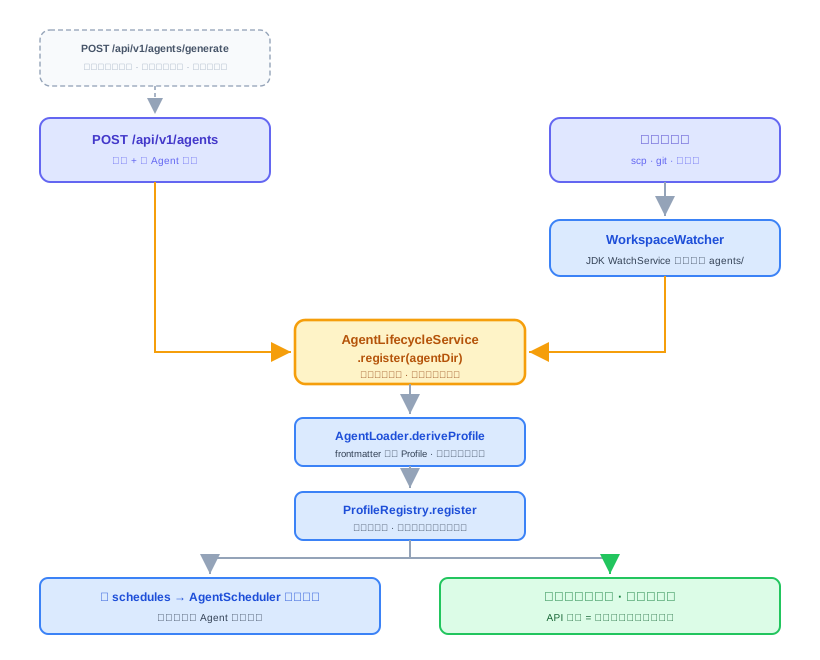
Dynamic management: three equivalent entrances
Agent CRUD is restart-free across the board, via three equivalent entrances:
- REST API: generate a draft from one sentence (
POST /api/v1/agents/generate, returned as a preview — not persisted, not registered); a human reviews it (especially schedules and tool permissions), thenPOST /api/v1/agentspersists and registers it - Web console: the Agent management page drives the same API group, covering "one-sentence create → preview & edit → create → edit → delete"; a workspace page browses the directory tree read-only
- Drop the directory: put a finished Agent directory into
.yokeos/agents/; the foundation watches for changes, validates, and loads it — plug and play
.yokeos/agents/ is the single source of truth; generation is audited, and an invalid LLM-drafted definition returns a clear validation error — never a silent failure.
The workspace
Agent directories live inside a .yokeos/ workspace (created by yokeos init, idempotent, never overwrites):
.yokeos/
├── agents/            # each subdirectory = one Agent
├── skills/            # shared skill library (one SKILL.md per subdirectory)
├── output/            # agent artifacts
├── memory/
│   └── MEMORY.md      # long-term memory
├── sessions/          # session export (source of truth is SQLite)
├── logs/              # structured logs
├── AGENTS.md          # bootstrap: project-level agent behavior
├── SOUL.md            # bootstrap: default agent persona
├── USER.md            # bootstrap: user preferences (read-only to agents)
├── mcp_servers.yaml   # MCP configuration
└── yokeos.db          # SQLite
Skills: reusable capability templates
Reusable procedural knowledge lives in the shared skill library: .yokeos/skills/<name>/, one SKILL.md per subdirectory, compatible with the agentskills.io open standard. An Agent references skills by name in its frontmatter (skills: [name]); the foundation injects the referenced bodies into the system prompt to tightly constrain output. The boundary is crisp: a Skill is not a Tool — it never enters the tool registry; loading and injection belong to the context layer.
Target usage
The two daily demos in Quick Start each show a different richness of definition: the daily weather agent is a bare AGENT.md; the daily tech digest agent references a shared formatting skill by name and adds MCP servers.
Phase 1 boundaries
- One-sentence drafts are previews — no draft approval flows, no agent versioning, no cross-instance sync
- Skill bodies are injected whole; progressive disclosure (metadata first, body on demand) comes in the extension phase
- An agent with scripts inherits the trust of its author — whitelisting an interpreter grants code execution; container-grade isolation comes later