
Provider Routing (Capability 1: LLM Access)
In one sentence: a Provider abstraction unifies mainstream LLMs — Agents never know which vendor they're talking to, switching at runtime takes zero code changes, and local inference is supported.
What it solves
Without this layer, every provider switch means rewriting call code and re-handling vendor protocol quirks. YokeOS folds that complexity behind one Provider interface: mainstream models (DeepSeek, Qwen, Kimi, GLM, Hunyuan, Doubao, Anthropic, OpenAI…) connect through Spring AI Alibaba's ready-made connectors, wrapped by YokeOS into uniform Providers — no wheel reinvention. What this enables: simple tasks on cheap models, complex tasks on strong ones, on the same foundation; connect the enterprise's own local inference (Ollama, vLLM) so data never leaves; multiple providers side by side — draft with a cheap model, synthesize with a strong one.
How it works
A thin wrapper — not zero layers, not a thick one. Calling the framework's ChatClient/ChatModel directly (zero layers) is the shortest path, but cross-cutting concerns — multi-provider mapping, token accounting, provider status — scatter across callers. A thick layer (re-inventing a communication protocol) repeats what the framework already does. The middle path: ProviderService forwards calls, holds the map, and records audit — without touching protocols.
Explicit mapping, never type scanning. With multiple providers configured, the container holds multiple ChatModel beans of the same type; "scan all beans" cannot reliably tell deepseek from kimi. YokeOS maintains an explicit provider name → ChatModel map: each provider declares a unique name, ProviderService builds the map at startup, and agents reference providers by name.
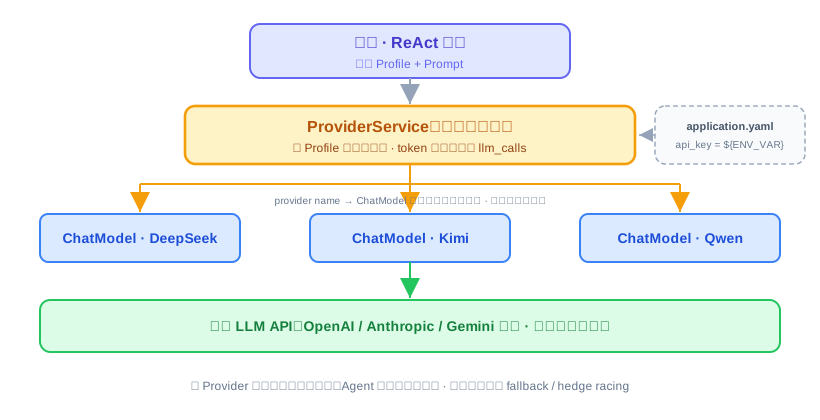
Every call is audited. When the ReAct loop calls the LLM with a Profile and Prompt, ProviderService selects the underlying model, completes the call, and writes token usage and duration into the llm_calls table — basic cost transparency from Phase 1.
Configuration and secrets. API keys use ${ENV_VAR} placeholders resolved from the environment, never written in plaintext; configuration is validated on load — missing or invalid values produce clear errors, never silent failures.
Target usage
# AGENT.md frontmatter — switching vendors is a one-line change
provider:
  name: deepseek          # → qwen / kimi / ollama, just this line
  model: deepseek-chat
  api_key: ${DEEPSEEK_API_KEY}
With multiple providers, different agents bind different providers; per-task routing within one agent is an extension-phase concern (see boundaries).
Phase 1 boundaries
- No fallback or hedge racing: provider failures surface as errors to the agent; failover chains and circuit breakers come in the extension phase
- Cost transparency is basic-only (tokens, provider, model into the audit table); full cost aggregation and dashboards come later
- The one-sentence agent generator uses its own default-provider config key; when unset it does not silently fall back — the call returns a clear error instead