
ReAct Loop (Capability 2: the Agent's Brain)
In one sentence: the Agent's reasoning engine, self-implemented — the LLM decides whether and which tool to call, the foundation executes and feeds the result back, the LLM decides the next step. Loop behavior stays fully controllable.
What it solves
A bare model only generates text; multi-step work needs an engine driving the think → act → observe loop. Handing that engine to an external framework buys convenience at the price of a black box: loop behavior can't be customized, tool execution isn't yours, and failures can't be traced. YokeOS implements it in-house — the core loop is a few dozen lines of Java, giving complete command of how Agents work and room to customize later. What this enables: agents decide when and which tools to call without hard-coded flows; multi-step tasks complete within one conversation (read a file, analyze, call an API, generate a report); complex business processes need no pre-orchestration — the agent chooses its execution path at runtime.
How it works
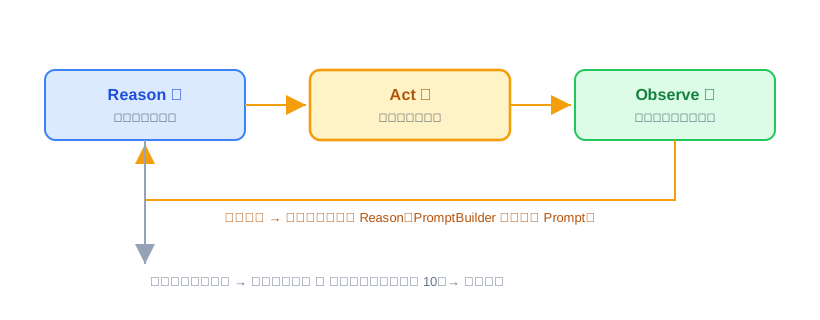
The algorithm
- Append the user message to the session history
- Assemble the prompt (system prompt + bootstrap + skills + long-term memory + history + available tools)
- Call the LLM provider
- No tool call in the response → return the final response
- Has a tool call → execute the tool, append the result as a tool message
- Back to step 2
- At the iteration cap (default 10, overridable per agent) force-stop
The modules
ReActLoop — the core engine. Takes a session and a user message, returns the final response; tracks iterations, calls ProviderService for LLM calls and ToolExecutor for tools, accumulating every response and tool result into the session history.
PromptBuilder — assembles each turn's prompt in a fixed order:
- System prompt (
AGENT.mdbody + bootstrap files + referenced skill bodies; suffixed with the current date and time — the LLM doesn't know today's date on its own; in scheduled scenarios "today" rests entirely on this line) - Memory injection (conversation history + long-term memory)
- Conversation history (truncated by
max_history_turns) - This agent's available tools, in Function Calling format
ToolExecutor — executes the LLM's tool calls: find the tool in the ToolRegistry, run the sandbox check, execute, wrap the result as a ToolResult, and write the tool_invocations audit record. Failures retry with exponential backoff, three attempts by default.
AgentService — the unified entry shared by all three trigger sources: stage the current profile into the request context, run the loop, persist the session, clean up.
The protocol-adapter boundary
Vendor protocol differences (OpenAI tools, Anthropic tools, Gemini function declarations) are absorbed by Spring AI's format translation — but the framework's built-in automatic tool execution is explicitly disabled. Tool scheduling and execution belong entirely to ReActLoop + ToolExecutor; otherwise tools get called twice.
Target usage
You: Check the recent nginx error logs; if something's wrong, push it to the team channel
    → Turn 1: LLM calls shell (tail the error log) → whitelist check → execute → feed back
    → Turn 2: LLM sees 502s, calls notify with a summary → whitelist check → execute → feed back
    → Turn 3: no more tool calls — final response returned
One conversation, a multi-step task, fully traced: every LLM call lands in llm_calls, every tool call in tool_invocations.
Phase 1 boundaries
- No parallel tool calls (multiple calls in one response execute in order)
- No agent-to-agent delegation, no streaming responses (SSE)
- Context overflow uses simple truncation (keep the system prompt and the most recent N turns); summarization-based compression comes in the extension phase