
Memory (Capability 3: Agents That Remember)
In one sentence: two memory layers — session memory survives restarts, long-term memory survives conversations — so agents remember your preferences, project context, and past decisions without being told twice.
What it solves
An ordinary chatbot starts from zero every time. The core experience that separates an Agent foundation from a chatbot is an agent that knows you better the longer you use it. What this enables: remembering preferences across conversations ("I use Spring Boot, not Spring MVC"); resuming after interruptions mid-task; traceable decisions ("why did we pick DeepSeek over Kimi last time?"); teams sharing one user's preference memory across agents.
How it works
One facade, two layers
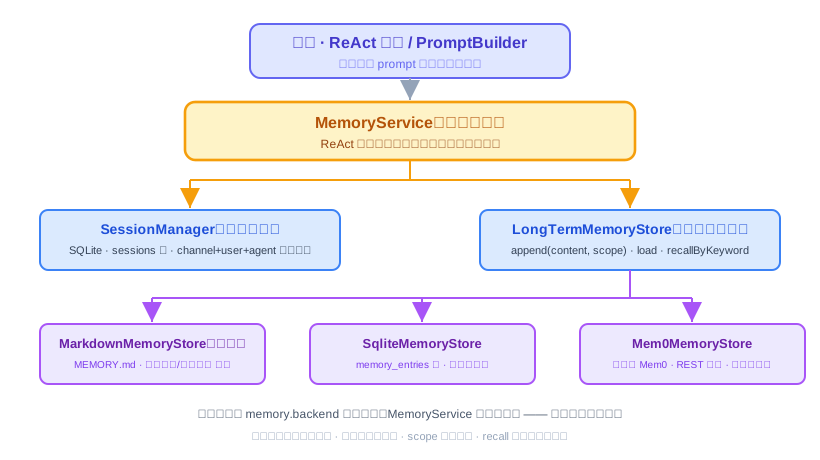
The ReAct loop sees a single MemoryService interface; the layers live inside:
- Session memory: the full conversation history, keyed by channel + user + agent, persisted to SQLite, restorable across restarts; truncated from the front when it exceeds the context window
- Long-term memory: a
MEMORY.mdfile (default backend) that agents read and write through two built-in tools —save_memory(content)appends,recall_memory(query)searches by keyword; the whole file is injected into the system prompt at startup
Core and archival partitions
MEMORY.md is organized into two top-level partitions:
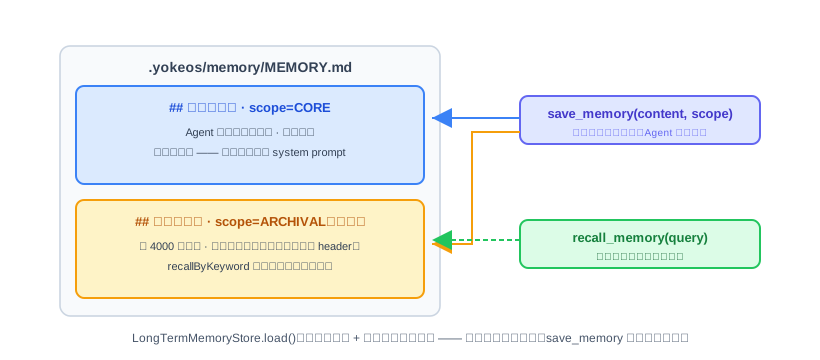
- Core memory: the few facts that must always be present — injected in full, never truncated
- Archival memory: general facts and history, keeping the most recent content past 4,000 characters;
recall_memorysearches only the archival partition (the core partition is already fully injected)
Writing to core or archival is the agent's explicit choice via the scope parameter — the system never guesses. Phase 1 has no automatic extraction: the agent decides what to remember through when it calls save_memory.
Three backends, delivered together
Long-term memory sits behind the LongTermMemoryStore interface (append / load / recallByKeyword); three implementations switch on one config line, memory.backend, and nothing above MemoryService changes:
| Backend | Underlying store | Best for |
|---|---|---|
MarkdownMemoryStore (default) | one MEMORY.md file | Zero dependencies, human-readable, git-trackable; single-node tier |
SqliteMemoryStore | the memory_entries table; truncation becomes LIMIT, recall becomes LIKE | Thousands of entries, structured queries |
Mem0MemoryStore | self-hosted Mem0 (data stays in-house); extraction and semantic search delegated | When you truly need smart memory |
All three honor four contracts: no caching (fresh reads — save_memory is visible next turn); the core partition is never truncated; partition choice is explicit; recall is keyword search, kept simple.
MEMORY.md vs USER.md
| File | Origin | Read/write | Purpose |
|---|---|---|---|
USER.md | Written by the user | Read-only to YokeOS | The user's "initial settings" (bootstrap file) |
MEMORY.md | Written by the agent via save_memory | Read-write | The agent's "growth record" (long-term memory) |
Target usage
You: From now on, digests should focus on AI and chips only
    → the agent calls save_memory(content="user prefers AI and chip coverage")

(The next day, the daily tech digest fires on schedule)
    → MEMORY.md is in the system prompt
    → the digest naturally leans toward AI and chip items
Memory actually working across days is one of the acceptance points of the daily tech digest demo.
Phase 1 boundaries
- No automatic fact extraction from conversations (partitions driven entirely by the agent's own calls)
- No in-process vector store; semantic search is delegated externally by the Mem0 tier — the knowledge base and semantic memory plan belongs to the extension phase
- No episodic memory (a third layer), no Memory Wiki (claim/evidence, contradiction detection), no compression (oversize is simply truncated)