
Architecture Overview
YokeOS is a Spring Boot monolith: two human-facing entrances plus one automated entrance, converging on a single engine; the engine orchestrates three capability blocks; below them sits one storage layer. Everything converges into one process — "one binary, install and run."
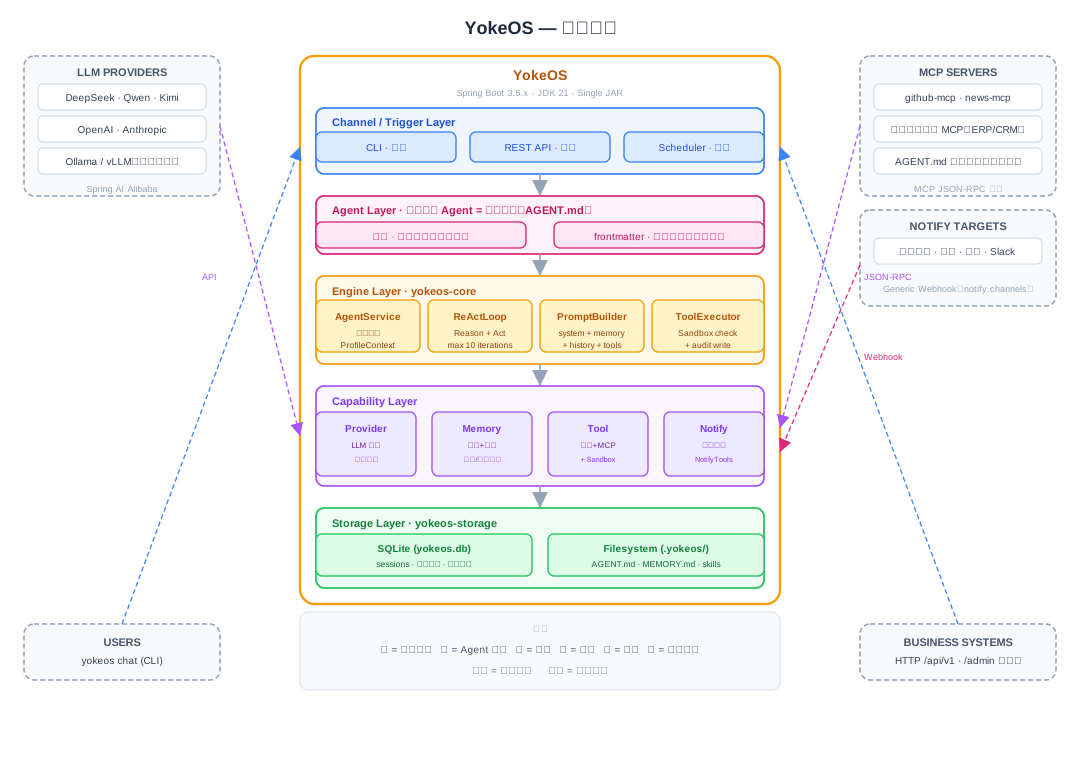
Four layers
Top to bottom:
- Access (CLI Channel, the Web Service REST API,
AgentSchedulercron triggers) — messages in and out - Engine (
ReActLoop,PromptBuilder,ToolExecutor) — the Agent's brain - Capabilities (Provider, Memory, Tool) — LLM calls, context, and execution for the engine
- Foundation (agent/skill/bootstrap loading, session storage, SQLite, config and secrets) — the engineering substrate
Three trigger sources: human-pushed and clock-pushed
CLI and the Web Service are "human-pushed" — someone initiates a call. The AgentScheduler is "clock-pushed" — it generates and sends a message automatically when a cron expression comes due. Messages from all three entrances converge on the same AgentService, the unified entry point that doesn't care where a message came from: one execution path, consistent behavior, a uniform audit trail.
How the six capabilities relate
The six capabilities are not parallel feature modules — they have explicit working relationships:
- The ReAct loop (capability 2) is the engine that drives "user message → LLM thinking → tool execution → result feedback → continue"
- Provider (capability 1) supplies LLM calls — invoked once per reasoning turn
- Memory (capability 3) supplies context — injected into every prompt assembly
- Tool (capability 4) supplies execution — the LLM decides which tool to call; the engine executes it
- Notify & schedule (capability 5) are two symmetric pieces: Notify is the outbound channel (inbound, Channels solve "how do messages get in"; Notify solves "where do results go"); the scheduler is the third trigger path
- The Web service (capability 6) is the outbound face of the internal capabilities, wrapping them as REST APIs for business systems
In one sentence: Provider, Memory, and Tool feed the ReAct engine; notify and scheduling add the outbound channel and the third trigger source; the engine's capabilities reach the outside through CLI, Web Service, and cron.
Modules
YokeOS is a Maven multi-module project with nine modules (boundaries aligned with the reference implementation):
| Module | Responsibility |
|---|---|
yokeos-core | Core abstractions: YokeTool, Session, Profile, AgentLoader, ContextLoader, ReActLoop, PromptBuilder, ToolExecutor, AgentService, AgentScheduler |
yokeos-provider | Capability 1: ProviderService, Function Calling adapter, explicit provider-name mapping |
yokeos-memory | Capability 3: MemoryService facade, LongTermMemoryStore backends, MemoryTools |
yokeos-tool | Capability 4: built-in tools, MCP client, ToolRegistry, Sandbox interface + whitelist implementation, notify adapters |
yokeos-channel-cli | CLI Channel: the yokeos chat implementation |
yokeos-web | Capability 6: REST controllers, web console hosting, unified exception handling, OpenAPI |
yokeos-storage | Persistence: SQLite, session/audit/schedule repositories |
yokeos-cli | CLI entry: Picocli main, 12 subcommands, ConfigLoader |
yokeos-boot | Spring Boot startup module: main class, auto-configuration, dependency aggregation |
Modules decouple through interfaces: cross-module contracts live in yokeos-core and are implemented downstream (dependency inversion); circular dependencies are forbidden. Adding a new Channel or Tool in the extension phase means adding a module — yokeos-core stays untouched.
Two architectural points
- Convergence: all capabilities converge into one engine, one storage, one process. External dependencies (LLM APIs, external MCP servers) stay outside the application boundary — YokeOS binds to none of them.
- Decoupling: engine↔capability and capability↔external boundaries are abstract interfaces, so the extension phase adds new Channels, Providers, and Tools at the edges without touching the core engine.
Key decisions at a glance
| Decision | Choice |
|---|---|
| ReAct loop implementation | Self-implemented; no framework agent abstractions |
| Framework usage boundary | Protocol translation + @Tool schema generation only; auto tool execution disabled |
| Provider abstraction | Thin ProviderService wrapper + explicit name → ChatModel map |
| Execution model | Synchronous blocking + Java 21 virtual threads |
| Sandbox strategy | Interface first: Sandbox abstraction + WhitelistSandbox implementation |
| Persistence | SQLite + Spring Data JPA + the MEMORY.md file |
Next steps
Layer-by-layer design: Provider Routing · ReAct Loop · Memory · Tool System & Sandbox · Notify & Schedule · Web Service