
Notify & Schedule (Capability 5: Reaching Humans, Running Unattended)
In one sentence: Notify is the outbound channel — agents deliver results where people will see them; scheduled tasks are the third trigger source — agents run on time with nobody pressing the button. Both reuse the same execution path as human pushes.
What it solves
CLI and the Web Service are conversational — someone sends a message in and waits for the reply. Daily digests, inspections, and summaries have no one waiting: the AgentScheduler fires on schedule, and unless the agent can push its result to where people actually look (the enterprise IM group), the run sinks without a trace. What this enables: reports, inspections, and digests run on their own without a human standing by; results reach people proactively via group-bot webhooks; every scheduled execution is persisted and queryable — whether it ran, what it did, all on record.
How it works
Notify: the outbound channel
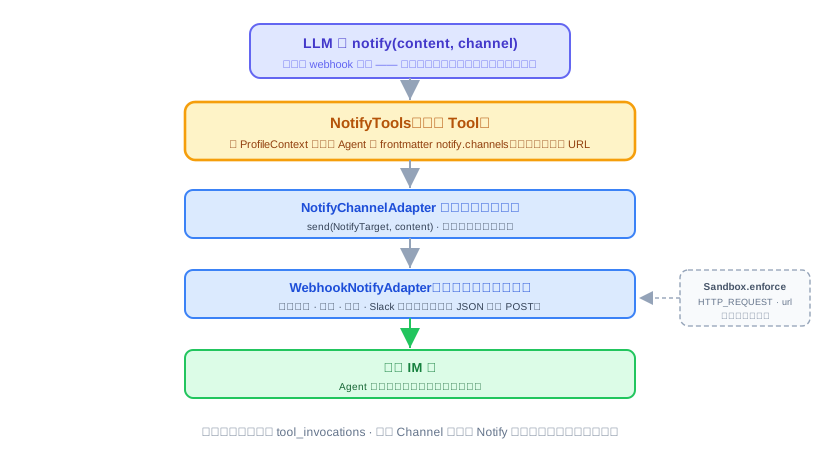
The NotifyChannelAdapter interface expresses "deliver this content to that notification target" — modeled separately from inbound channels because the semantic direction is opposite. Phase 1's only implementation is the WebhookNotifyAdapter: one generic HTTP webhook covers every scenario — WeCom, Feishu, DingTalk, and Slack group bots all expose webhook URLs, so no per-vendor SDK integration is needed.
An agent declares notify.channels in its frontmatter (each with name, type: webhook, config) and calls the built-in notify(content, channel) tool with just the content — never the webhook address, which is runtime configuration, not conversation material. Before sending, the push passes the domain whitelist (shared with http_post); the push is written to the audit tables.
Scheduled tasks: the third trigger source
Each agent declares cron rules, time zones, and the message to send in its frontmatter's schedules field. The AgentScheduler dynamically registers tasks on Spring's ThreadPoolTaskScheduler + CronTrigger — not static @Scheduled annotations, because trigger rules are derived from agent definitions and can't be frozen at compile time.
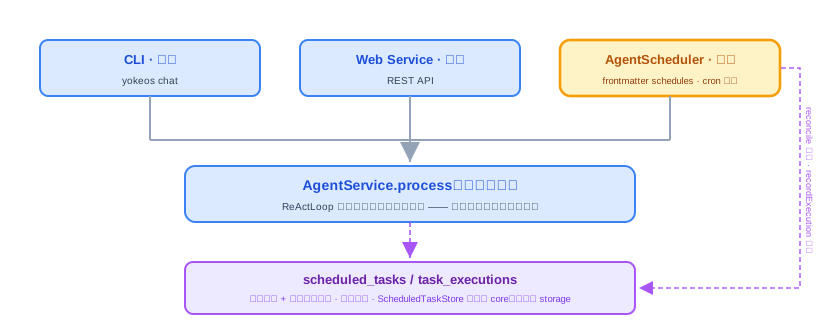
- One path: a clock-pushed message calls the same
AgentServiceentrance; theReActLoopnever knows this run was scheduled. The same agent can be triggered manually for verification (yokeos chatorPOST /agents/{name}/invoke) - Concurrency control: one in-process lock per task — if the previous run hasn't finished, the next trigger point is skipped; no queuing, no double runs
- Session identity: scheduled runs get sessions too — the
session_idformula stays the same with channel and user fixed toscheduler; consecutive scheduled runs share one session, and no new concepts are invented for scheduling - Persisted state: two tables —
scheduled_tasks(registrations and run status) andtask_executions(history of every run, success or failure) — survive restarts; definitions still come from the frontmatter, re-reconciled from files on boot
Target usage
# AGENT.md frontmatter
schedules:
  - cron: "0 0 8 * * ?"     # every morning at 8
notify:
  channels:
    - name: team-im
      type: webhook
      config: {}              # webhook URL etc.
On schedule: the AgentScheduler fires → the agent runs its full ReAct loop → notify(content="...") pushes to the group bot → everything audited and queryable. That's the skeleton of the daily weather demo.
Phase 1 boundaries
- Only the Webhook adapter ships; email and native IM SDK adapters come in the extension phase
- The scheduler's runtime-control endpoints (task status, execution history, run-now, enable/disable) are explicitly deferred — Phase 1's "queryable" rests on the two tables plus session queries and the audit tables
- The per-task lock covers one process only, not distributed coordination; multi-instance coordination arrives with the distributed foundation phase